Break Bulk Shipping vs Container Shipping: Which Is Right for Large Cargo?
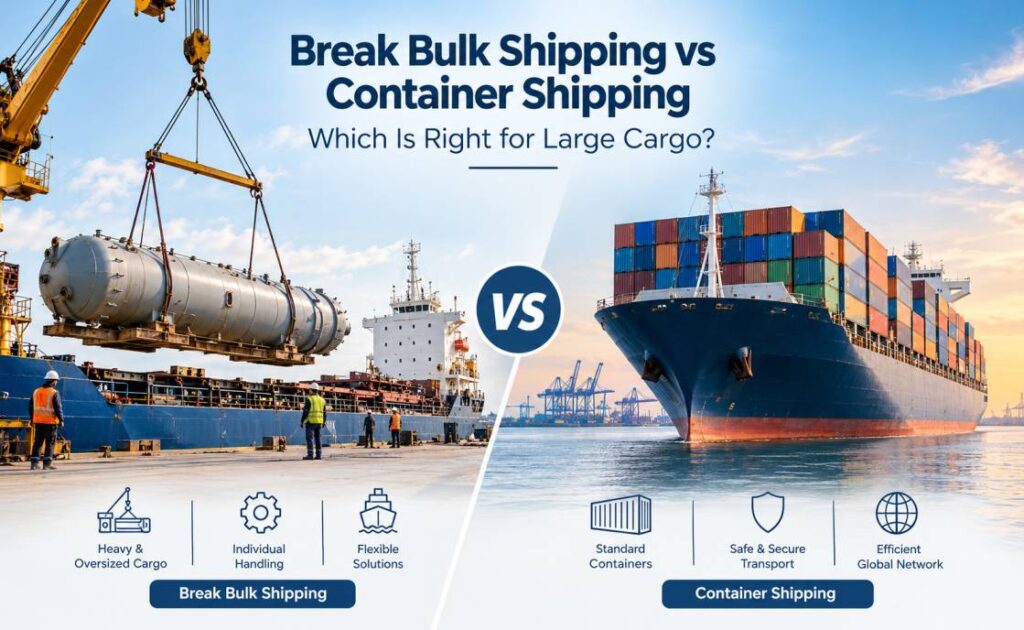
Choosing the right shipping method for large cargo is not simply about finding the lowest freight rate. The cargo’s dimensions, weight, shape, handling requirements, destination port, inland route, and delivery schedule can all affect the best option.
For standard goods, container shipping is often the most practical choice. But large machinery, industrial equipment, structural components, and other specialised cargo may require a different approach.
This is where break bulk shipping services can become useful. Instead of placing cargo inside a standard container, breakbulk cargo is handled and transported as individual units. Depending on the cargo, other options such as flat-rack containers, open-top containers, or RoRo shipping may also be suitable.
So, which method is right for large cargo? The answer depends on what you are shipping and how it can be handled safely and efficiently.
What Is Break Bulk Shipping?
Break bulk shipping involves transporting cargo as individual pieces or units rather than as standard sealed containers. Cargo is loaded, positioned, secured, and unloaded separately using suitable handling equipment.
Breakbulk is commonly associated with heavy, oversized, irregularly shaped, or project cargo, but cargo does not have to be extremely large to be handled as breakbulk. Items such as machinery, steel products, pipes, timber bundles, crates, and other cargo that is not practical to containerise can also move this way.
Common examples include:
- Heavy industrial machinery
- Generators and transformers
- Steel beams and structural components
- Pipes and long sections
- Turbines and industrial equipment
- Construction machinery
- Large tanks and boilers
- Project cargo
- Other irregular or specialised cargo
The main difference is the way the cargo is handled and transported, rather than simply how large it is.
How Does Container Shipping Work?
Container shipping uses standardised equipment, such as 20-foot and 40-foot containers, to transport cargo between ports. Goods are packed and secured inside the container, allowing the container itself to be moved between ships, trucks, rail services, and terminals.
This standardisation makes container shipping particularly effective for cargo that fits within the available dimensions and weight limits.
It is commonly used for:
- Packaged machinery
- Spare parts
- Manufactured products
- Consumer goods
- Palletised cargo
- General commercial freight
- Regular import and export shipments
For suitable cargo, containerisation can reduce direct handling because the cargo remains inside the container during transfers.
Break Bulk Shipping vs Container Shipping
The two methods serve different cargo requirements.
Factor | Break Bulk Shipping | Container Shipping |
Cargo type | Individually handled, irregular, heavy or specialised cargo | Standardised packaged cargo |
Loading | Cargo is loaded and secured individually | Container is moved as one unit |
Dimensions | More flexible for oversized cargo | Limited by container dimensions |
Weight | Can accommodate heavy individual pieces, subject to vessel and equipment limits | Subject to container, vessel, road and handling limits |
Handling | Requires individual lifting, positioning and securing | More standardised handling |
Scheduling | Depends on suitable vessels and cargo requirements | Often more frequent on established routes |
Protection | Depends on packaging, stowage and securing | Cargo is enclosed in the container |
Best suited for | Project, industrial and specialised cargo | Regular commercial freight |
The important point is that breakbulk does not simply mean “cargo that is too big for a container.” The handling method, cargo characteristics, available equipment, and transport route all need to be considered.
When Should You Choose Break Bulk Shipping?
The first question should be:
Can the cargo be safely and practically transported using standard or specialised container equipment?
If the answer is no, breakbulk may be the more suitable option.
1. The Cargo Is Too Large for Available Container Equipment
Some machinery, structural components, tanks, vessels, and industrial equipment exceed the practical dimensions of standard containers.
Specialised equipment such as flat racks or open-top containers can sometimes accommodate cargo that is only oversized in one or more dimensions. When the cargo exceeds what these options can reasonably handle, non-containerised breakbulk transportation may be more appropriate.
2. The Cargo Is Extremely Heavy
Weight is another important consideration.
A cargo item may appear to fit inside a container but still exceed the applicable payload, lifting, road, terminal, or vessel limits. For heavy individual pieces, the available cranes, deck strength, lifting points, and port infrastructure need to be assessed before selecting the shipping method.
3. The Cargo Has an Irregular Shape
Long pipes, turbines, tanks, boilers, structural sections, and other unusual cargo can be difficult to pack efficiently inside a conventional container.
Breakbulk handling allows the cargo to be positioned and secured according to its actual dimensions and characteristics.
4. Dismantling Is Not Practical
Some machinery can be dismantled into smaller components, but doing so may create additional labour, packaging, handling, transportation, and reassembly requirements.
If the equipment can be safely moved as a complete unit, transporting it without unnecessary dismantling may be more practical.
5. The Shipment Is Part of a Larger Project
Construction, energy, manufacturing, mining, and infrastructure projects can involve multiple pieces of specialised cargo that need to reach a site according to a planned schedule.
In these cases, shipping is only one part of the process. Cargo surveys, lifting plans, securing, port handling, inland transportation, permits, and final delivery may all need to be coordinated.
When Is Container Shipping the Better Choice?
Container shipping is often the better option when cargo fits safely within the applicable container dimensions and weight limits.
It may be preferable when:
- The cargo has standard dimensions
- Goods can be safely packed inside containers
- Shipments are regular or frequent
- Established sailing schedules are important
- Cargo benefits from enclosed transportation
- The shipment contains many smaller packages
- No specialised lifting arrangement is required
Container shipping also benefits from standardised equipment and established handling systems, which can make recurring shipments easier to plan.
However, fitting inside a container is not the only consideration. The total logistics cost, handling requirements, route, port capabilities, and delivery schedule should also be reviewed.
What Are Flat-Rack and Open-Top Containers?
Not every oversized shipment needs to move as traditional breakbulk.
Flat-rack and open-top containers can provide an intermediate option for certain cargo.
A flat rack is useful for cargo that exceeds the internal dimensions of a standard container but can still be secured to specialised container equipment.
An open-top container can be useful when cargo is too tall to load through a conventional container door and needs to be loaded from above.
These options allow some specialised cargo to remain within the container shipping network. However, their suitability depends on the cargo’s exact dimensions, weight, securing requirements, available equipment, and carrier acceptance.
If cargo exceeds the practical limits of these options, breakbulk may need to be considered.
Break Bulk vs OOG vs Project Cargo: What’s the Difference?
These terms are often used together, but they do not mean exactly the same thing.
Break Bulk
Breakbulk generally refers to cargo that is transported and handled individually rather than as a standard containerised unit.
Out-of-Gauge Cargo
Out-of-Gauge (OOG) cargo exceeds the standard dimensions or weight limits applicable to normal containerised transportation. Some OOG cargo can still be transported using specialised equipment such as flat racks or open-top containers.
Project Cargo
Project cargo is a broader logistics category usually associated with complex industrial, infrastructure, energy, construction, or other major projects. It may include oversized, overweight, specialised, or time-sensitive cargo.
A single project shipment can therefore contain a mixture of containerised cargo, OOG cargo, breakbulk cargo, and other specialised movements.
Understanding this difference is important because not every oversized shipment automatically requires a breakbulk vessel.
What About RoRo Shipping?
RoRo, or roll-on/roll-off shipping, is another option for certain types of large cargo.
It can be particularly useful for wheeled or self-propelled equipment such as:
- Construction machinery
- Trucks
- Buses
- Trailers
- Agricultural machinery
- Certain industrial vehicles
Instead of being lifted into a container, suitable cargo can be driven or towed onto the vessel using ramps or specialised loading equipment.
For cargo that is naturally mobile, RoRo can sometimes reduce handling compared with lifting the item as conventional breakbulk cargo. Its suitability still depends on vessel availability, cargo dimensions, weight, route, and port facilities.
How Much Does Break Bulk Shipping Cost Compared With Container Shipping?
There is no fixed rule that breakbulk will always cost more or that container shipping will always be cheaper.
Standard container shipping benefits from highly standardised handling, which can make it efficient for regular cargo. Breakbulk movements may involve additional planning, lifting, securing, port handling, specialised equipment, and cargo-specific arrangements.
However, the basic ocean freight rate should not be the only figure considered.
For example, a container shipment may require additional costs for:
- Flat-rack or open-top equipment
- Out-of-gauge handling
- Special securing
- Cargo dismantling
- Additional packaging
- Special lifting arrangements
- Inland transportation restrictions
- Reassembly at the destination
Breakbulk may also involve specialised handling and planning costs.
The better approach is to compare the total logistics cost, including origin handling, ocean transport, port operations, inland transportation, equipment, permits, securing, and other cargo-specific requirements.
What Should You Check Before Choosing a Shipping Method?
Before requesting a quotation, prepare accurate information about the cargo.
Cargo Dimensions
Provide the exact length, width, and height of each major cargo unit. Approximate measurements can lead to incorrect equipment or routing decisions.
Gross Weight
The total shipment weight matters, but the weight of each individual piece is also important when planning lifting and vessel handling.
Centre of Gravity and Lifting Points
Heavy machinery may require specific lifting points. The centre of gravity can also affect how the cargo needs to be lifted, positioned, and secured.
Cargo Condition and Fragility
Determine whether the cargo requires special packaging, weather protection, shock protection, or other handling measures.
Port Facilities
Check whether the origin and destination ports have suitable cranes, lifting capacity, berth access, storage areas, and other infrastructure required for the cargo.
Inland Transportation
The shipment does not end when it reaches the port.
Large cargo may require route surveys, special vehicles, road permits, bridge clearance checks, or other arrangements before it can reach its final destination.
Delivery Schedule
The required delivery date can influence vessel selection and shipping method. Container services often have more frequent scheduled sailings on established routes, while specialised cargo movements may depend more heavily on suitable vessel and equipment availability.
When Do Break Bulk Chartering Solutions Make Sense?
For particularly complex shipments, booking available space on a regular service may not provide enough flexibility.
Break bulk chartering solutions can be considered when cargo requirements call for a specific vessel, capacity, route, loading arrangement, or schedule.
This can be relevant for:
- Large industrial projects
- Multiple heavy cargo units
- Oversized machinery
- Infrastructure components
- Energy equipment
- Cargo requiring specialised lifting arrangements
- Shipments with unusual port requirements
Vessel selection should not be based only on total cargo capacity. Factors such as the dimensions and weight of individual pieces, lifting equipment, deck strength, cargo securing requirements, port capabilities, and route need to be considered.
For large project movements, early planning can help identify vessel and port limitations before the cargo reaches the loading stage.
A Simple Way to Choose the Right Shipping Method
A practical decision process can look like this:
Cargo fits safely inside a standard container →
Container shipping is usually the first option to evaluate.
Cargo does not fit a standard container but can be transported using suitable specialised container equipment →
Consider a flat rack or open-top container.
Cargo is too large, heavy, irregular, or otherwise unsuitable for practical containerisation →
Evaluate breakbulk transportation.
Cargo is wheeled or self-propelled and suitable for ramp loading →
Consider RoRo as another option.
Cargo is part of a complex industrial or infrastructure project →
Evaluate the complete project logistics requirement, which may combine several shipping methods.
Several large cargo units require specific vessel capacity or scheduling →
Consider whether break bulk chartering solutions are appropriate.
Final Thoughts
Choosing between break bulk shipping and container shipping depends on the cargo’s size, weight, shape, handling needs, and delivery requirements. Container shipping is often suitable for standard cargo, while flat racks, open-top containers, or RoRo can work for certain specialised shipments.
Breakbulk is a practical option when cargo needs individual handling or cannot be efficiently transported using conventional container equipment. Before selecting a method, consider cargo dimensions, lifting requirements, port facilities, inland transportation, schedule, and total logistics costs.
For complex or specialised cargo movements, KGE Global can help assess the shipping requirements and identify a suitable transportation solution.